
 By
By 
Kitchen countertop, flooring, and cabinet materials
When it’s time to update a kitchen, it’s not always possible or within budget to do it all. Some kitchen projects are limited to replacing only some things. For instance, maybe the floors and cabinets are staying. Or just one or the other. Whatever you’re planning, it’s helpful to think of your kitchen as a collection of elements that need to come together.
Sometimes there will be choices to make. In other words, there’s flexibility in your palette. In other cases, though, some colors and textures are fixed and will inform the countertop palette and finish you have available.
Fixed Finishes Set the Starting Point
If your kitchen update in Davie will involve keeping either the cabinets or floors, start with whichever is staying. Then, as you’re browsing countertop slabs, keep in mind how well a candidate ties the kitchen’s existing palette together; the practical side of how to match countertop tone to floor and cabinets in Davie starts there. A countertop can unify the palette of your kitchen. Or, in a project where elements are staying and others are new, the wrong choice will shout that some finishes were installed at one time, while others were put in place decades apart by accident.
Dated Travertine Works Best With Calmer Surfaces
Here the palette of the kitchen includes tan travertine flooring with pits that have been filled with darker-colored grout. The kitchen’s palette will expand with the introduction of the countertop color and finish. Then it’ll be toned down again when new doors are painted.
In a kitchen like this, it’s helpful to sort through the range of colors, which Britannica covers at britannica.com/science/color, in the floors before deciding what goes with them. In this case the travertine includes shades of cream, sand, pale peach, gray-beige, and darker-toned pits. Since the floors are busy, a calmer countertop is a good idea. This is especially true if the countertops will be busy hubs of activity, be it cooking and entertaining, homework, or a landing zone for keys, purses, and the morning’s mail piled up on a peninsula.
All this being considered, if cabinets will be painted, consider colors like a soft white, a light mushroom color, a muted greige. Then pair them with countertops with a warm-white color with some movement: a couple of darker-toned veins or taupe-gray movement or some darker-toned (brown) specks. Avoid countertops with a stark-white background and dramatic charcoal-gray veining. This type of countertop can make older travertine, especially in kitchens where afternoon light streams through the sliding glass doors to the patio, look dated and yellowed by comparison.
Espresso Cabinets Need a Visual Bridge
The range of colors in this kitchen starts with richly-hued espresso-colored cabinet doors over plank flooring that’s on the paler end of wood tones and has movement: a couple of gray-toned knots here and there; longer-than-usual grain lines. In kitchens like this, a bridge is called for; something neutral but with some warmth. If you’re planning to remove upper cabinets, remember that the countertop will become a bold element in its own right: a wide, horizontal band that will be on display against whatever material you use on open shelving.
The range of countertop candidates here is pretty broad: beige-gray, light brown-gray, warm-white with darker-toned movement or specks, creamy-white with veins of sand, taupe, caramel, etc. Since there’s a lot of movement in the floors, keep the backsplash pretty neutral. A busy countertop pattern will shout in competition with the floors’ palette. Avoid super-dark (near-black) countertops. They will read as blocks of color in an otherwise neutral kitchen.
Test Large Samples in the Actual Kitchen
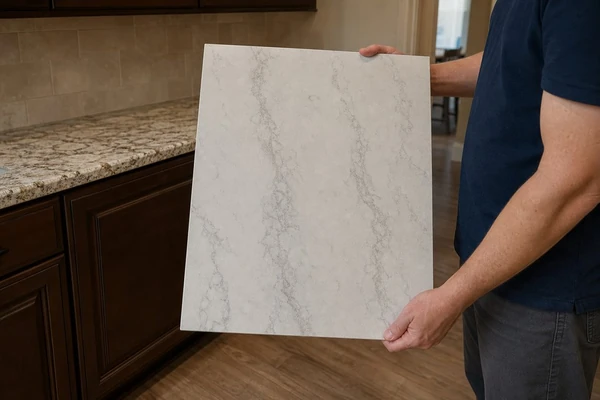
Countertop, cabinet, and flooring samples
Once you’ve got an idea of the range of countertop colors, finishes, etc. that will harmonize with what’s already installed, bring larger-than-usual samples (think dinner-plate-size instead of two-inch squares) home. Larger-sized samples will give you a sense of how a candidate’s finish, background color, veining, etc. will work with elements already installed. Look at how they work together during different times of the day, especially if there are large windows where the countertops will sit. Also, look at how candidates look in shadows (think tall pantries) as well as under artificial lighting: pendant lights, under-cabinet lights (especially if they’re on the warmer-toned side of white).
Assemble the Palette Before Fabrication
Before visiting the slab yard, gather up flooring and cabinet-door samples. Lay them all together (rather than spread them out over the span of several feet), either on top of existing countertops or a piece of cardboard. Take a look at everything together.
Lay out some objects you use daily on top of the samples – a stainless-steel utensil or two, a cutting board, a plate – and take a look at how they all read together. Snap a couple of photos, too, but don’t edit them or add filters. Compare them side-by-side later on and pay attention to whether you prefer how they read in person or via the camera’s eye. Then, as you browse countertops at the yard, take all this into account.



Comments